Value Stream Management: Measuring Flow and Business ROI
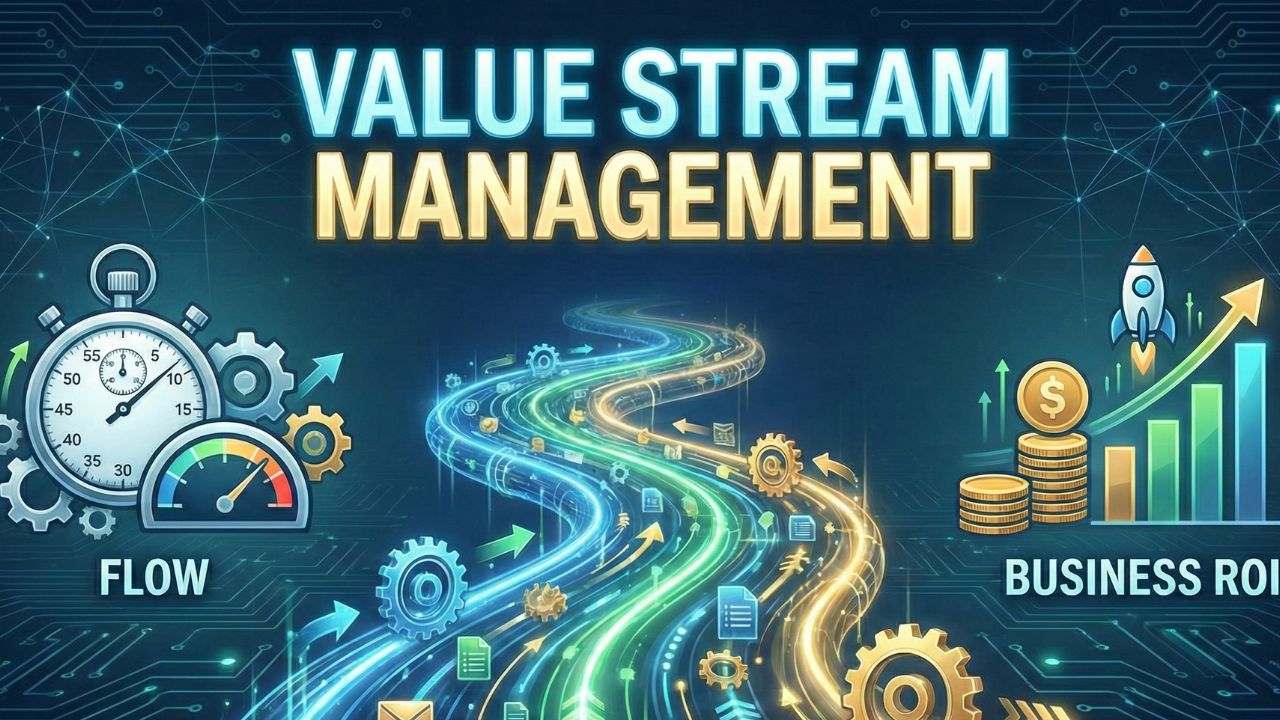
For modern technology leaders, traditional Agile metrics like Velocity and Story Points are meaningless to the CFO. The only metric that matters is Flow—the speed and efficiency with which an organization can turn an idea into money or realized customer value.
Value Stream Management (VSM) is the discipline that makes this possible. It is the end-to-end view of your software delivery pipeline, from the moment a customer requests a feature (Concept) to the moment the feature is earning revenue (Cash). VSM is the only reliable way to calculate the true ROI of agile transformation in 2026.
1. Flow Metrics vs. Velocity: The Measurement Shift
Agile teams historically focused on Velocity, which is an internal measure of output. VSM introduces **Flow Metrics**, which are external, outcome-focused measures of throughput that drive business decisions.
The Four Key Flow Metrics:
- Flow Time (Lead Time): The total time elapsed from start to finish. This is the single most important metric for time-to-market analysis.
- Flow Efficiency: The ratio of active working time to total Flow Time (Processing Time / Flow Time). This identifies organizational waste (Waiting Time).
- Flow Load: The number of items currently in the value stream. High Flow Load is a leading indicator of bottlenecks.
- Flow Distribution: The mix of work (Feature, Defect, Risk, Debt). This ensures teams balance new value creation with maintenance work.
2. How to Map Your First Value Stream
Value Stream Mapping is the foundational practice of VSM. It is the critical exercise for identifying bottlenecks in software delivery that traditional Kanban boards often hide.
The following steps align with the modern VSM approach:
Step-by-Step VSM Mapping for DevOps
- Identify the Trigger (Start): Choose a single, repeatable customer request (e.g., 'New Feature Request' or 'Production Bug Fix') that initiates the flow of work.
- Map the Handoffs: Physically map every major handoff, from ideation to deployment. Include all teams involved (Product, Dev, QA, Ops, Legal).
- Measure Time: For each step, capture two data points:
- Processing Time (PT): The time spent actively working on the item.
- Waiting Time (WT): The time the item spends idle, waiting for the next team or approval.
- Calculate Flow Efficiency: Use the formula below to find the massive amounts of hidden waste. This is the goal of cycle time vs lead time analysis.
- Prioritize Bottlenecks: Bottlenecks are revealed where WT is significantly higher than PT. These are the single most important areas for improvement.
3. Calculating Flow Efficiency and ROI
The power of VSM is in its ability to connect process metrics to financial ROI. Flow Efficiency calculation is your most potent tool for measuring business value in agile. Most software value streams operate at an efficiency between 5% and 15%. This means 85% to 95% of your time is spent waiting.
The ROI of Flow Improvement:
If you have a Flow Time of 100 days and an efficiency of 10% (10 days of work), simply reducing the waiting time by 50 days (a 50% improvement) immediately drops your Flow Time to 50 days. This means your features—and the associated revenue—reach the market twice as fast, directly translating into ROI of Agile transformation 2026.
Frequently Asked Questions (FAQ)
A: Flow Time (or Lead Time) is the total elapsed time from the moment the customer requests the feature until it is delivered (Concept to Cash). Cycle Time is typically measured only during the active development phase. Flow Time is the superior measure for business ROI.
A: Flow Efficiency is calculated by dividing the total Active Working Time (Processing Time) by the total Flow Time (Processing Time + Waiting Time). A low efficiency means your highest priority is to eliminate idle waiting states, not to make the developers work faster.
A: No, VSM is complementary. Agile/Scrum optimizes the work *within* a team. VSM optimizes the flow of work *across* the entire organization, helping leaders prioritize the most valuable cross-team impediments.
A: Popular VSM tools include products from Planview, Tasktop (now Planview), and Harness. However, successful VSM starts with mapping and metrics, not tools. Begin with basic data from Jira/Azure DevOps before investing heavily in dedicated platforms.
