Strategic Portfolio Management: Aligning OKRs with Execution
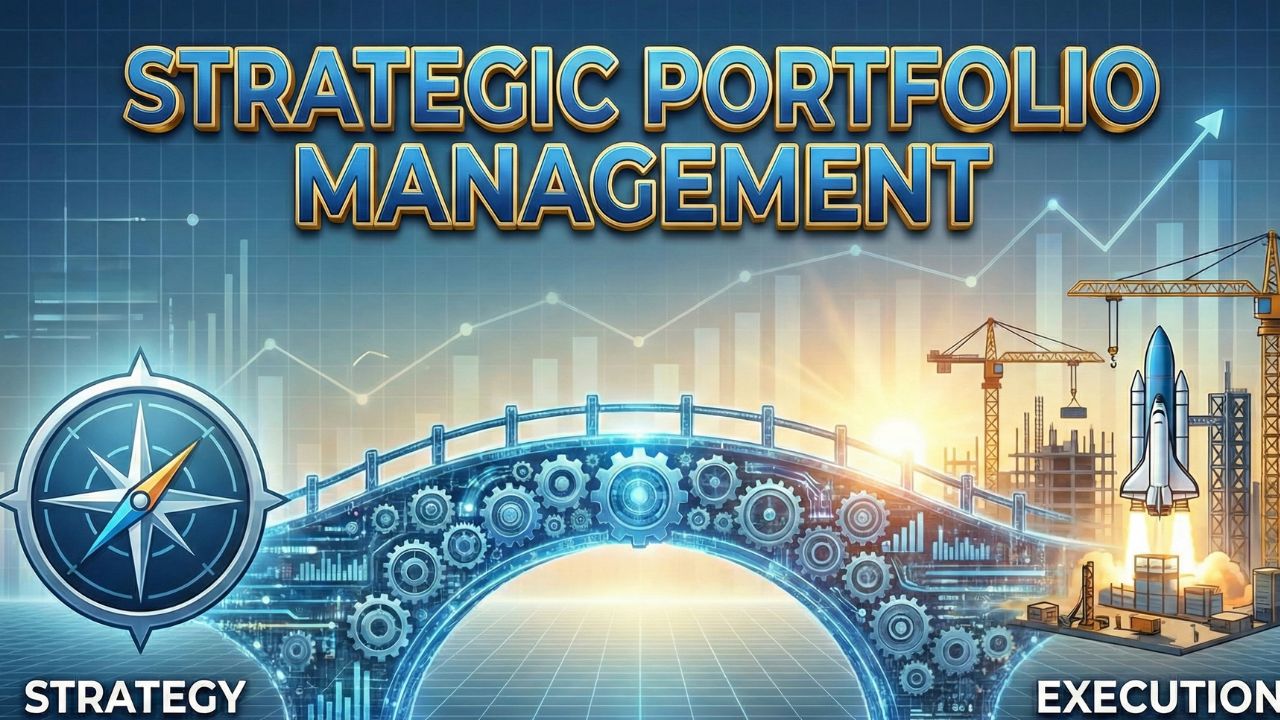
For technology leaders, the primary challenge is no longer just how to run an efficient team, but how to ensure that every engineering dollar spent is perfectly aligned with the top-level corporate strategy. This disconnect is where Strategic Portfolio Management (SPM) delivers massive value.
SPM is the governance layer that ensures your budget, resources, and teams are all focused on the handful of strategic initiatives that will actually move the needle for the business.
1. The Foundation: Lean Portfolio Management (LPM)
Traditional Portfolio Management relies on annual, fixed-scope projects. **Lean Portfolio Management (LPM)** replaces this rigid structure with flexible, value-driven funding for long-lived **Value Streams** (see our guide on VSM).
LPM focuses on three dimensions:
- Strategy & Investment Funding: Shifting funding from projects to value streams, giving execution teams greater autonomy within a budget guardrail.
- Agile Portfolio Operations: Coordinating value streams and managing the flow of work from ideation to delivery.
- Governance: Managing capacity, mitigating risk, and measuring performance using outcome-focused metrics.
This approach moves the agile PMO roles and responsibilities away from being a command-and-control gatekeeper to a financial and operational coach.
2. Connecting Strategy to Execution using OKRs
How do we connect the CEO's goal of "Expand into the APAC market" to a developer's Jira ticket? Through the OKR framework for large enterprises.
OKRs (Objectives and Key Results) are the language that bridges this gap:
- Portfolio Level: Objective (e.g., "Achieve market leadership in APAC"). Key Results (e.g., "Increase APAC revenue by 40%").
- Epic/Initiative Level: Epics (major features) are tied directly to Key Results. They define the 'what' we are building to move the needle.
- Team Level: User Stories (backlog items) are prioritized based on their contribution to the Epic, ensuring every sprint contributes to a strategic goal.
This structure provides clear traceability, making data-driven decision making for the CTO far simpler: if a feature doesn't move a Key Result, it should not be built.
3. Prioritization with Economic Weighting (Cost of Delay)
In SPM, features are not prioritized by politics or seniority, but by economic value. The most powerful tool for this is **Cost of Delay (CoD)**.
CoD is the business value lost by delaying a feature. It forces decision-makers to quantify the business impact (revenue lost, penalty incurred, or competitive disadvantage gained) of not starting work immediately.
Prioritizing Features by Cost of Delay (CoD)
The best practice is to use **Weighted Shortest Job First (WSJF)**, which uses CoD as its numerator:
WSJF is the ultimate data-driven decision making for CTOs because it ensures you work on the feature that provides the highest economic benefit in the shortest time.
4. The Portfolio Kanban: Managing Flow at the Top Level
The Portfolio Kanban provides a visual overview of all proposed, approved, and currently executing Epics across the enterprise. It is the central mechanism for Agile Portfolio Operations.
Key to the portfolio kanban examples is the use of **Work-in-Progress (WIP) limits**. These limits prevent the portfolio from starting too many initiatives, which is the single biggest impediment to fast delivery. By limiting WIP, you force the entire leadership team to prioritize, ensuring focus and faster flow of value.
Frequently Asked Questions (FAQ)
A: The Agile PMO (or LACE/APMO) shifts its focus from tracking project milestones to enabling flow. Their new responsibilities include facilitating the Portfolio Kanban, managing funding guards, and ensuring that value streams are measured using Flow Metrics, acting as a governance coach rather than a command-and-control function.
A: CoD attempts to quantify the economic loss incurred by delaying a feature. It is calculated as the sum of Revenue, Operational savings, or other value benefits lost per week/month of delay. The goal is to tackle the feature with the highest CoD first, maximizing economic benefit.
A: OKRs (Objectives and Key Results) provide the necessary outcome focus. Corporate Objectives are translated into Portfolio Epics, which are then broken down into Features and User Stories. This ensures every team's work directly contributes to the top-level Objectives, connecting strategy to execution.
A: Popular tools include Planview, Jira Align, and Azure DevOps Portfolio Management. The best software is one that supports value stream funding, visualizes the Portfolio Kanban, and facilitates WSJF prioritization.

Sources & References
- Scaled Agile Framework (SAFe) - Lean Portfolio Management (Detailed guidance on LPM structure and governance).
- John Doerr's OKR Resources (Foundational principles for using OKRs to drive strategy).
- VSM vs. Agile Portfolio Management Analysis (Content exploring the synergy between Flow and Portfolio management).