The Business Value & FinOps: ROI-Driven Leadership 2026
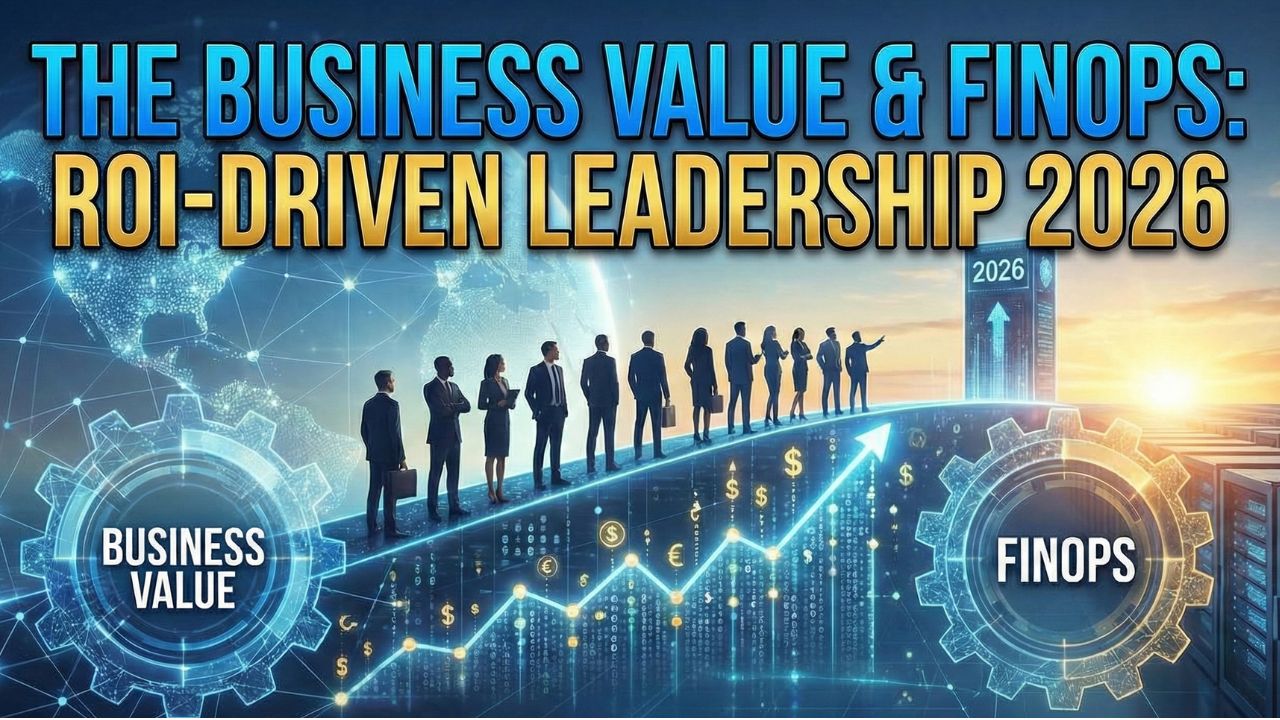
As we approach 2026, the mandate for technology leaders is shifting. The era of "growth at all costs" is over. Today, C-Suite executives, Boards, and Investors are no longer asking "How fast are we moving?" (Velocity). They are asking "How much money are we saving or generating?" (Value).
This content hub, The Business Value & FinOps: ROI-Driven Leadership 2026, is designed for the modern Agile Leader who must now act as a bridge between Engineering and Finance. It moves beyond standard Scrum rituals to address the hard economic realities of software delivery: Cloud Unit Economics, Flow Efficiency, Strategic ROI, and Developer Productivity.
Whether you are a CTO, VP of Engineering, or an Agile Coach looking to speak the language of the CFO, this hub provides the frameworks and metrics you need to justify budgets, optimize spend, and prove the return on investment (ROI) of your digital transformation.
Explore the Core Pillars of ROI-Driven Leadership
We have broken down this complex landscape into four strategic areas. Explore the sections below to deep-dive into the "Money and Measurement" side of Agility.
1. Agile FinOps: Mastering Cloud Costs & Unit Economics
The cloud is no longer just an IT line item; it is a primary driver of COGS (Cost of Goods Sold). "Agile FinOps" is the practice of bringing financial accountability to the variable spend model of the cloud.
This section covers how to shift from reactive cost-cutting to proactive "Unit Economics"—understanding exactly how much it costs to support one customer or deliver one feature.
Key Topics:
- Cloud cost optimization strategies.
- Forecasting IT spend with AI.
- Reducing AWS/Azure bills without stifling innovation.
Why it matters: Stop bleeding cash and start treating infrastructure as a strategic investment.
Read More: Agile FinOps & Cloud Economics Learn how to integrate financial signals into sprint planning2. Value Stream Management (VSM): Measuring Flow & Business ROI
Traditional Agile metrics like "Velocity" and "Story Points" are vanity metrics to the Board. Value Stream Management (VSM) focuses on the end-to-end flow of value from "Customer Request" to "Cash."
This section guides you through measuring what actually matters: Flow Time, Flow Efficiency, and the bottlenecks that are silently killing your time-to-market.
Key Topics:
- Flow metrics vs. Velocity.
- Identifying bottlenecks.
- The ROI of agile transformation.
Why it matters: Move the conversation from "how busy we are" to "how much value we delivered."
Read More: Value Stream Management (VSM) Discover tools to visualize your delivery pipeline3. Strategic Portfolio Management: Aligning OKRs with Execution
The biggest waste in software development isn't "inefficient coding"—it's building the wrong thing efficiently. Strategic Portfolio Management (SPM) ensures that every sprint, epic, and feature aligns directly with corporate Objectives and Key Results (OKRs).
This section explores the governance frameworks required to connect high-level strategy with day-to-day execution.
Key Topics:
- Connecting strategy to execution.
- Lean Portfolio Management (LPM).
- Data-driven decision-making for CTOs.
Why it matters: Ensure your engineering output directly impacts the company's bottom line.
Read More: Strategic Portfolio Management Bridge the gap between Boardroom strategy and Team backlog4. Platform Engineering: The Future of DevOps & Efficiency
"You build it, you run it" has led to massive cognitive load and developer burnout. The industry solution for 2026 is Platform Engineering—treating your internal infrastructure as a product.
By building Internal Developer Platforms (IDPs), leaders can standardize tooling, improve security, and drastically reduce the "tax" developers pay to ship code.
Key Topics:
- Platform Engineering vs. DevOps.
- Building Internal Developer Platforms (IDPs).
- Measuring Developer Experience (DevEx).
Why it matters: Increase efficiency by enabling self-service infrastructure for your agile teams.
Read More: Platform Engineering & DevOps Future Explore how to reduce cognitive loadFrequently Asked Questions (FAQ)
A: Standard cloud management is often a reactive IT function focused on keeping servers running. FinOps is a cultural practice that brings Finance, Engineering, and Business together to take ownership of cloud usage. It focuses on value—spending more is okay if it drives more revenue (Unit Economics).
A: In 2026, budgets are tight. If you cannot prove the cost-per-transaction or cost-per-feature, you cannot justify budget increases. Unit Economics allows you to speak the CFO's language: "We spent $10k more on cloud, but we supported 50k more users at a lower cost-per-user."
A: No, it is an evolution of DevOps. DevOps is the culture/philosophy; Platform Engineering is the implementation. It creates a "Golden Path" for developers, automating the complex DevOps tasks so teams can focus on coding rather than configuring Kubernetes clusters.
A: Stop counting "teams trained" or "certifications achieved." Measure ROI through Flow Metrics (Time-to-market reduction), Quality Metrics (Defect escape rate reduction), and Financial Metrics (OpEx reduction via efficiency).
