The Terminal-Bench 2.0 Score Anthropic Doesn't Headline
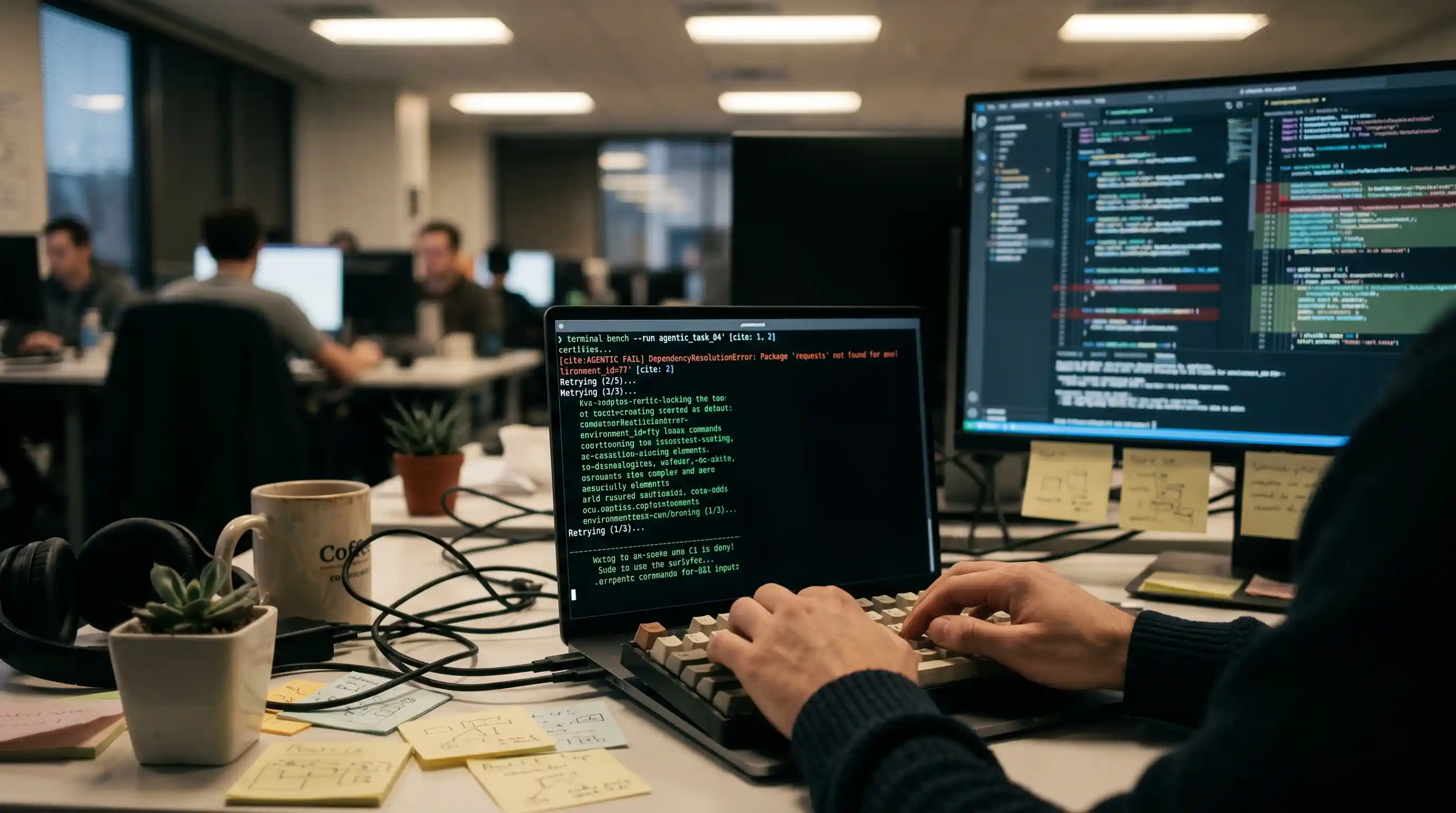
- The Operational Gap: Standard benchmarks abstract away the messy infrastructure and CLI layer where true enterprise ROI is realized.
- Agentic Execution: Terminal-Bench 2.0 scores models on multi-step shell tasks, including dependency installation, environment configuration, and test suite debugging.
- The Real Leader: As of May 2026, GPT-5 Codex holds the leadership position for multi-tool shell execution over Claude Opus.
- Procurement Weighting: Platform engineering teams running CI/CD or infrastructure agents should weight Terminal-Bench at 15–20% in their vendor scorecards.
Anthropic’s Claude Opus may dominate the standard diff-editing leaderboards, but a "model that can fix a bug" is vastly different from a "model that can configure a CI/CD pipeline, debug a failing container, and apply the fix end-to-end".
The messy operational layer of enterprise software is exactly where most marketing metrics fall apart. To build a truly procurement-defensible stack, enterprise architecture teams must look beyond isolated syntax scores and consult the complete AI coding benchmarks decoded hub.
When forced to execute multi-step shell commands natively, the rankings shift dramatically, exposing the Terminal-Bench 2.0 score Anthropic quietly downplays.
Why Terminal-Bench 2.0 Measures What Aider Can't
The fundamental flaw in modern enterprise AI procurement is treating coding as a purely text-editing exercise. Aider Polyglot is an exceptional tool for measuring whether a model can produce syntactically valid code diffs.
However, Aider completely abstracts away the shell environment. Real-world enterprise developers do not just write functions; they navigate complex, stateful file systems and wrangle broken dependencies.
If your vendor is heavily weighting Aider or SWE-Bench Verified scores, they are selling you an IDE-bound assistant, not an autonomous engineer capable of terminal execution.
The Shell and Multi-Tool Execution Gap
Terminal-Bench 2.0 strictly evaluates multi-step shell tasks. An agent must successfully navigate the file system, configure local environments, and read bash outputs.
This requires a fundamentally different reasoning architecture than closed-book code generation. The agent must parse cryptic build failures and iteratively apply patches without human intervention.
For teams aiming to measure full desktop automation, coupling this metric with real-world scenarios provides the ultimate predictor of production ROI.
The Terminal-Bench Leaderboard Agentic Coding Reality
When you analyze the terminal-bench leaderboard agentic coding data for 2026, the Pareto frontier fragments. The model that wins the syntax race does not always win the execution race.
As of May 2026, GPT-5 Codex leads Terminal-Bench 2.0 specifically due to its superior multi-tool sequences and shell-driven execution paths.
Anthropic’s Claude Opus—while dominant on Aider's diff-edit split and SWE-Bench Pro—quietly trails when forced into these complex, un-scaffolded terminal environments.
Integrating Terminal-Bench into Enterprise RFPs
Procurement teams must align their benchmark weighting with actual engineering workflows. A DevOps or platform engineering team running terminal-driven agents should explicitly weight Terminal-Bench highest.
At a minimum, any scorecard involving agents that touch CI/CD pipelines or infrastructure should assign a 15–20% weight to Terminal-Bench 2.0.
To validate vendor claims and ensure you aren't paying a premium for a purely IDE-based model, mandate a workload-matched bake-off. Use rigorous frameworks to force vendors to disclose their exact multi-tool execution scores before contract signature.

Frequently Asked Questions (FAQ)
It is a highly specialized ranking system that scores AI models on their ability to execute multi-step shell tasks. Instead of just editing code, it measures an agent's capability to natively operate within a terminal environment to resolve issues end-to-end.
Terminal-Bench 2.0 features a significantly expanded scope, updating monthly to include new, complex task categories. It rigorously stresses multi-tool sequences, making it much harder for naive base models to pass without advanced reasoning and file-system navigation skills.
As of May 2026, GPT-5 Codex currently leads the Terminal-Bench 2.0 leaderboard. It excels specifically in multi-tool sequences and terminal-driven execution, outperforming competitors like Claude Opus in this specific operational layer.
SWE-Bench primarily abstracts the operational environment to focus on issue resolution via code patching. Terminal-Bench forces the agent to handle the messy reality of configuring environments, debugging build failures, and applying patches directly via the shell.
Yes, shell execution is the foundational metric. It evaluates if an AI agent can successfully chain together shell commands—like installing dependencies or running test suites—without hallucinating syntax or breaking the local environment.
Scores are derived from the successful, end-to-end completion of multi-step terminal tasks. The agent must successfully navigate the file system, execute the correct shell commands, and resolve the underlying infrastructure or code issue natively.
Absolutely. The benchmark is designed to create a head-to-head matrix for these specific enterprise tools. It clearly delineates which agents excel at raw terminal execution versus those that rely heavily on graphical IDE scaffolding.
It is the most accurate and fair benchmark available today for this specific use case. For enterprises deploying agents into CI/CD pipelines or headless server environments, Terminal-Bench is the closest proxy to real-world production behavior.
The benchmark contains a vast, continuously updated suite of tasks spanning various operational categories. These range from simple dependency updates to complex, multi-repo build debugging scenarios that mimic enterprise DevOps workflows.
Vendors prefer to highlight Aider or SWE-Bench scores because they are often structurally higher and easier to inflate with custom scaffolding. Terminal-Bench exposes weaknesses in raw environment configuration that many high-profile models still struggle to master.