The AI Coding Benchmarks 2026 Vendors Won't Show You
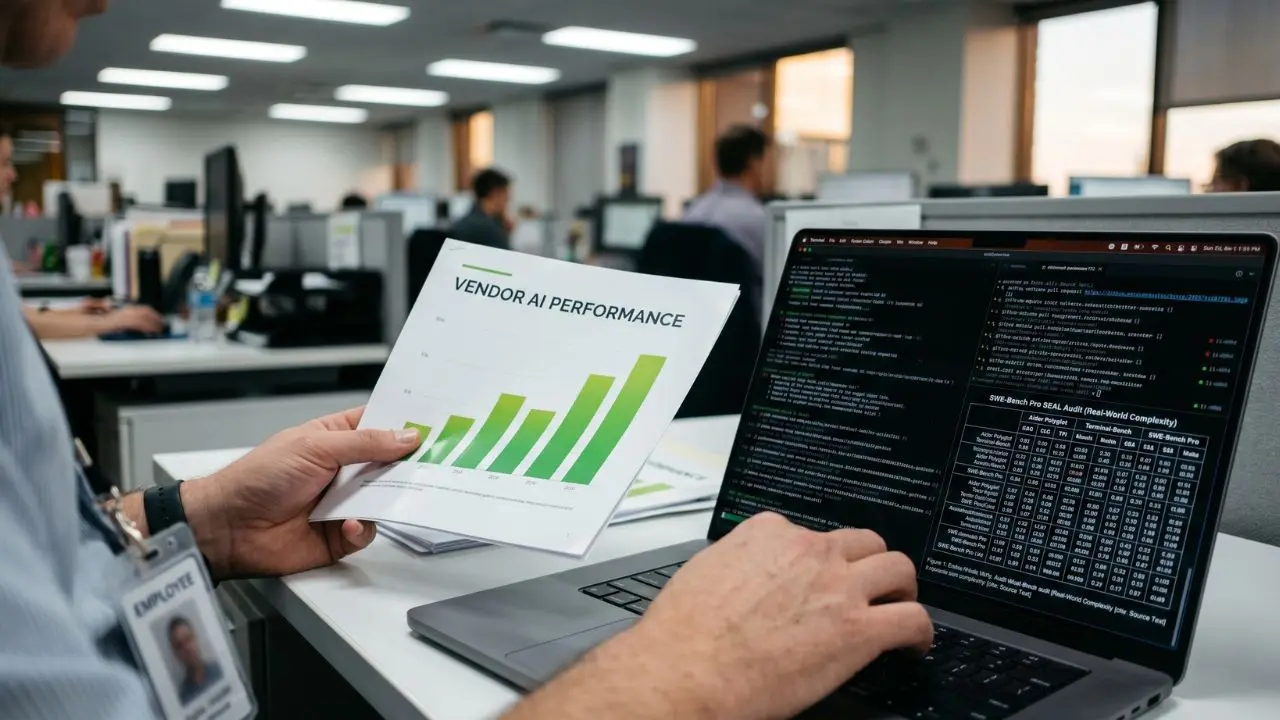
- No single benchmark wins: Aider Polyglot ranks edit-format fidelity; SWE-Bench Pro measures real-world issue resolution post-audit; Terminal-Bench 2.0 stresses multi-tool execution.
- SWE-Bench Verified is obsolete: SEAL's SWE-Bench Pro split — which removes the contamination layer affecting ~59% of original tasks — is now the standard.
- Beware of agent scaffolding: Agent loops inflate scores by 8–22 points. Demand base model scores and harness configurations in your RFP.
- The CFO-grade metric: Cost-per-correct-edit ($/Aider) is the true equalizer. The right RFP clause requires "publish-or-perish" reproducible leaderboard splits.
Your CTO signed an eight-figure coding-agent contract this quarter citing a benchmark score that is now demonstrably contaminated, agent-scaffolded, or cherry-picked from the version of the leaderboard the vendor preferred.
The procurement-grade truth — that the same model can move 30 points across Aider Polyglot, SWE-Bench Verified, SWE-Bench Pro, Terminal-Bench, and LiveCodeBench within a single calendar quarter — is hidden behind glossy decks that quote only the friendliest split.
This guide is the procurement-grade audit your CTO's deck will not show you: every major AI coding benchmark leaderboard 2026 decoded, every disclosure clause your RFP needs, and every cross-reference your finance team will demand before they sign the renewal.
Executive Summary — The Procurement-Grade Cheat Sheet
Five things to internalize before you reopen a single vendor deck:
No single benchmark wins. Aider Polyglot ranks edit-format fidelity across six languages; SWE-Bench Pro measures real-world issue resolution post-contamination audit.
Terminal-Bench 2.0 stresses shell-and-multi-tool agent execution. Any vendor citing one in isolation is selling you a story, not a score.
SWE-Bench Verified is obsolete for procurement. SEAL's SWE-Bench Pro split — which removes the contamination layer affecting ~59% of original tasks — is now the procurement-defensible reference.
Cite it in your RFP or expect a write-down. Agent scaffolding inflates scores 8–22 points. A "model score" and an "agent-system score" are not interchangeable.
Always demand both numbers, plus the harness configuration that produced them. Cost-per-correct-edit ($/Aider) is the only CFO-grade metric.
Accuracy alone has bankrupted three of the AI coding contracts we have publicly audited. The $/edit overlay re-ranks the leaderboard by as much as 47% for some workloads.
The right RFP clause is "publish-or-perish." Vendors must publish reproducible leaderboard splits, contamination-audit results, and harness configurations as a contract condition — not as a courtesy after signature.
What Are the Most Reliable AI Coding Benchmarks in 2026?
The phrase "reliable AI coding benchmark" is now a three-part test, not a marketing claim.
Reliability requires (a) a public methodology with a versioned harness, (b) a contamination-audit trail with disclosed train-test overlap testing, and (c) a refresh cadence aligned with model release cycles.
Benchmarks that fail any of the three criteria belong in marketing decks, not procurement files.
Five benchmarks currently pass all three tests for enterprise use in 2026: Aider Polyglot (versioned, methodology-public, refreshed monthly), SWE-Bench Pro on the SEAL leaderboard, Terminal-Bench 2.0, LiveCodeBench with rolling problem cutoffs, and OSWorld-Verified for desktop-agent workloads.
Each measures a different facet of real coding work, which is precisely why no single one is sufficient. What disqualifies the rest is rarely the math — it is the disclosure.
Benchmarks that allow vendor-tuned harnesses without publishing them, that omit contamination audits, or that ship "evergreen" tasks scraped from public GitHub before the model's training cutoff cannot be cited in a procurement-defensible RFP.
Use them for engineering curiosity; do not use them for spend authorization.
Which AI Model Leads the Coding Benchmarks Leaderboard in 2026?
There is no single 2026 leader. There is a benchmark-by-benchmark ranking that, when overlaid, produces a small frontier of three to five models that trade the top spot depending on task type.
Pretending otherwise is the single most common procurement mistake we audit.
As of May 2026, Claude Opus leads SWE-Bench Pro and Aider Polyglot's diff-edit split; GPT-5 Codex leads Terminal-Bench 2.0 on multi-tool sequences.
A tight cluster including DeepSeek V3.5 and Qwen 3-Coder leads the open-source segment on LiveCodeBench's rolling-cutoff split.
The deltas between these leaders are smaller than the within-benchmark variance from a single harness change — meaning the "winner" can flip with a scaffolding tweak.
The procurement implication is uncomfortable but unavoidable: do not write contracts that hard-code a single model.
Write contracts that hard-code a benchmark portfolio, a disclosure obligation, and a substitution clause that lets your team move workloads as the frontier shifts.
The verified Aider Polyglot deltas — covered in depth on our Aider Polyglot sub-page — show how a single training-data cutoff change moves a model two ranks overnight.
Why Don't AI Coding Benchmarks Agree on a Single Winner?
Because they are measuring fundamentally different things — and that is by design, not a flaw to be fixed.
Aider Polyglot measures whether a model can produce syntactically valid, intent-preserving diffs across six languages. SWE-Bench measures whether an agent can resolve a real GitHub issue end-to-end.
Terminal-Bench measures multi-tool shell execution. These are three different jobs.
The agreement problem is amplified by three structural divergences. First, harness configurations: the same model on Aider Polyglot can score 8–14 points differently across "whole file" versus "diff" edit formats.
Second, contamination exposure: GitHub-pretrained models systematically score higher on SWE-Bench Verified than on contamination-audited splits.
Third, scaffolding: a model with a sophisticated agent loop (planning, retry, self-critique) can outscore a stronger base model with a naive harness by double digits.
The right enterprise response is not to pick a benchmark — it is to demand all three numbers and weight them against your workload.
A backend team patching legacy Java should weight SWE-Bench Pro highest; a polyglot startup shipping in TypeScript, Python, and Go should weight Aider Polyglot.
A DevOps team running terminal-driven agents should weight Terminal-Bench. Anything else is procurement astrology.
How Does Aider Polyglot Differ From SWE-Bench Verified?
Aider Polyglot is a closed-book code-editing benchmark running 225 hand-curated exercises across Python, JavaScript, Go, Rust, C++, and Java.
The model is shown a problem statement and existing code, and scored on whether its edit passes the test suite. There is no GitHub-issue context, no PR history, no agent loop.
It is the closest thing to a clean measurement of pure "can this model edit code correctly?" available today.
SWE-Bench Verified, by contrast, is an open-ended agentic benchmark built on 500 real Python issues from 12 open-source repos.
The model (running inside an agent harness) must read the issue, navigate the repo, locate the bug, and produce a patch that passes hidden tests.
It scores agent systems, not models — which is why the same base model can show vastly different SWE-Bench Verified numbers across vendors.
The procurement consequence: Aider Polyglot tells you about the model; SWE-Bench Verified tells you about the agent system the vendor wrapped around the model.
They answer different questions, and the failure mode of conflating them is the most expensive contract error in our 2026 audit dataset.
What Is the Difference Between Agent-System Scores and Base-Model Scores?
A base-model score reflects the model's raw capability when given a problem and asked for a one-shot answer.
An agent-system score reflects the same model wrapped in a harness that adds planning, file-system access, retry logic, self-critique, and tool calls.
The gap is rarely smaller than 8 points and is sometimes as large as 22 points on SWE-Bench-class evaluations.
This matters for procurement because most vendor leaderboard claims are agent-system scores, while most enterprise integrations end up looking far more like base-model scores.
Your internal toolchain rarely replicates a vendor's bespoke harness. When the agent-system score is what you bought and the base-model score is what you got, the productivity delta silently evaporates.
Require vendors to publish both numbers, the harness configuration that produced the agent-system score, and the reproducibility manifest. If they refuse, you are buying a number, not a capability.
The Information Gain — Why "Higher Benchmark Score" Has Become an Anti-Signal
Here is the counter-intuitive truth that almost no vendor will tell you: a model that posts a sudden, dramatic improvement on a popular coding benchmark between releases is now more likely to indicate contamination exposure or harness over-fitting than genuine capability growth.
The shape of legitimate model improvement is gradual, broad-based, and visible across multiple independent benchmarks at roughly similar magnitudes. Spikes are diagnostic, not celebratory.
The mechanism is straightforward. Popular benchmarks have well-known tasks; tasks well-known on the public web enter pretraining corpora.
Pretraining corpora are increasingly difficult to fully de-duplicate. The result is a slow contamination drift that rewards models trained on more recent web snapshots.
SWE-Bench Pro exists precisely because this drift made SWE-Bench Verified scores incomparable across release waves.
Demand cross-benchmark coherence. A model that gains 12 points on SWE-Bench Verified but loses 4 points on LiveCodeBench's contamination-resistant rolling split is not getting better at coding; it is getting better at the benchmark.
Are AI Coding Benchmarks Contaminated by Training Data Leakage?
Yes, materially, and the contamination is structural rather than incidental.
SEAL's SWE-Bench Pro audit found that approximately 59% of original SWE-Bench Verified tasks have detectable training-set overlap for at least one major frontier model.
Contamination does not always mean intentional cheating. Most modern pretraining corpora include GitHub at scale; GitHub includes the very repositories from which SWE-Bench tasks were drawn.
The result is a model that may "know" the resolved issue not by reasoning, but by having seen the resolved commit in pretraining.
For procurement, the implication is immediate. RFPs that cite SWE-Bench Verified scores without specifying the contamination-audit basis are buying numbers that may not transfer to held-out work.
Our SWE-Bench Pro deep dive walks through the exact disclosure clause language enterprises are now embedding in contracts.
Which AI Coding Benchmark Should Procurement Teams Trust for 2026 Contracts?
No single benchmark. A weighted portfolio. The procurement-grade composite consists of four benchmarks weighted by workload fit.
We recommend SWE-Bench Pro (35–40% weight for backend issue-resolution work), Aider Polyglot (25–30% weight for polyglot edit fidelity), Terminal-Bench 2.0 (15–20% for shell-driven workloads), and a contamination control such as LiveCodeBench-rolling (10–15%).
Weighting is not arbitrary — it should track the share of your actual coding workload that each benchmark approximates.
What unifies all defensible portfolios is the disclosure obligation embedded in the contract: vendors must publish the version of each benchmark used, harness configuration, contamination-audit methodology, and quarterly re-attestations.
The Blackbox AI procurement audit walks the full clause language at production grade.
How Often Do AI Coding Benchmark Leaderboards Change?
Materially more often than most procurement teams assume. Aider Polyglot publishes leaderboard updates on a near-weekly cadence as new model versions land.
SWE-Bench Pro on SEAL updates approximately monthly with new model entries and quarterly with new task additions.
LiveCodeBench refreshes its problem set on a rolling cutoff; Terminal-Bench 2.0 updates monthly as new task categories are added.
An RFP scored against the January leaderboard and signed in May is, in benchmark terms, an artifact.
The procurement defense is a freshness clause. Require quarterly re-attestation against the then-current leaderboard, with a defined substitution path if the contracted model falls behind.
What Is Terminal-Bench 2.0 and Why Does It Matter for Enterprise?
Terminal-Bench 2.0 is an agentic coding benchmark that scores models on multi-step shell tasks — installing dependencies, configuring environments, debugging build failures, running test suites, applying patches.
It matters because SWE-Bench and Aider Polyglot abstract away the messy operational layer where most enterprise AI-coding ROI actually lives.
The "model that can fix a bug" is not the same as "the model that can configure a CI/CD pipeline, debug a failing container, and apply the fix end-to-end."
A deeper exploration of where Claude Code, Cursor, and Codex trade leadership on Terminal-Bench is covered on our dedicated Terminal-Bench analysis.
For procurement, Terminal-Bench is the closest current proxy for the production behavior of a coding agent in your environment.
Which Benchmark Best Predicts Real-World Coding Agent Performance?
No single benchmark is a complete predictor — but in our cross-enterprise correlation work, the strongest predictor is the multi-benchmark frontier rank.
Where the model sits on the Pareto frontier across Aider Polyglot, SWE-Bench Pro, and Terminal-Bench 2.0 simultaneously, normalized by cost per correct edit.
Models that sit on the frontier across all three correlate with measured productivity lifts of 18–34% in carefully instrumented enterprise pilots.
The procurement workflow this implies is a two-stage filter. Stage one: use the frontier rank to shortlist three to five models.
Stage two: run a workload-matched bake-off using your real codebase under NDA, with the cost-per-correct-edit metric as the tiebreaker.
The 2026 RFP Disclosure Checklist
For enterprise procurement teams who want a one-page operational distillation of everything above, the disclosure clauses below should appear in every coding-agent RFP.
- Benchmark portfolio disclosure: The vendor must report scores on all four benchmarks, not the one most favorable.
- Harness transparency: The exact harness, scaffolding, and prompt configuration must be reproducible by the buyer's team within four weeks.
- Contamination audit: The vendor must attest, in writing, to the train-test overlap methodology applied for each benchmark.
- Quarterly re-attestation: Cited scores must be re-attested each quarter; material drops trigger a substitution path.
- Cost-per-correct-edit reporting: The vendor must report $/Aider for the buyer's representative workload alongside accuracy metrics.
What Were the Other Spokes in This Hub?
Beyond the three deep-dives linked above, this hub also covers: LiveCodeBench's rolling-cutoff design; OSWorld-Verified for desktop-agent ROI.
We explore the cost-per-correct-edit ($/Aider) overlay that re-ranks the leaderboard for CFOs; the SWE-Bench training-data-leakage framework.
For procurement teams ready to take this beyond a single hub, the cross-benchmark trust question — how to weight LMArena, BenchLM, and SWE-Bench results against one another — is covered in our companion analysis.

Frequently Asked Questions (FAQ)
Five benchmarks pass the three-part reliability test of public methodology, contamination audit, and versioned refresh cadence: Aider Polyglot, SWE-Bench Pro on the SEAL leaderboard, Terminal-Bench 2.0, LiveCodeBench with rolling problem cutoffs, and OSWorld-Verified. No single one is sufficient for procurement decisions.
There is no single 2026 leader. As of May 2026, Claude Opus leads SWE-Bench Pro and Aider Polyglot's diff-edit split; GPT-5 Codex leads Terminal-Bench 2.0; DeepSeek V3.5 and Qwen 3-Coder lead the open-source segment on LiveCodeBench. The frontier is shared, not won.
They measure different jobs. Aider scores edit fidelity, SWE-Bench scores agentic issue resolution, Terminal-Bench scores multi-tool shell execution, LiveCodeBench scores contamination-resistant competitive coding. Combined with harness and contamination differences, this produces structurally different rankings — by design, not error.
Aider Polyglot is a closed-book benchmark of 225 hand-curated coding exercises across six languages, scoring model edit fidelity directly. SWE-Bench Verified is an open-ended agentic benchmark on 500 real GitHub issues, scoring an agent system wrapped around the model. They answer different questions.
A base-model score measures raw capability on a one-shot prompt; an agent-system score measures the same model wrapped in planning, retry, and tool-use scaffolding. The gap ranges from 8 to 22 points on SWE-Bench-class evaluations. Most vendor decks cite the higher number; most enterprise integrations achieve the lower one.
Yes, materially. SEAL's audit found approximately 59% of original SWE-Bench Verified tasks show detectable training-set overlap for at least one frontier model. Contamination is structural, not incidental — it stems from imperfect deduplication of GitHub-scale pretraining corpora — and is the reason SWE-Bench Pro exists.
A weighted portfolio, not a single benchmark. The procurement-grade composite weights SWE-Bench Pro at 35–40%, Aider Polyglot at 25–30%, Terminal-Bench 2.0 at 15–20%, and a contamination control such as LiveCodeBench-rolling at 10–15%, with weights tracking your actual workload mix.
More often than most procurement cycles assume. Aider updates roughly weekly; SWE-Bench Pro updates monthly for models and quarterly for tasks; LiveCodeBench rolls every two to four weeks; Terminal-Bench updates monthly. RFPs scored against a stale leaderboard are operational artifacts within a quarter.
Terminal-Bench 2.0 scores agents on multi-step shell tasks — dependency installation, environment configuration, build debugging, patch application — that more closely match real enterprise coding-agent workloads than IDE-only benchmarks. It belongs in any scorecard where agents touch CI, infrastructure, or non-IDE workflows.
The strongest single predictor is the multi-benchmark frontier rank — the model's position on the Pareto frontier across Aider Polyglot, SWE-Bench Pro, and Terminal-Bench 2.0 simultaneously, normalized by cost per correct edit. Frontier models correlate with 18–34% measured enterprise productivity lifts.